
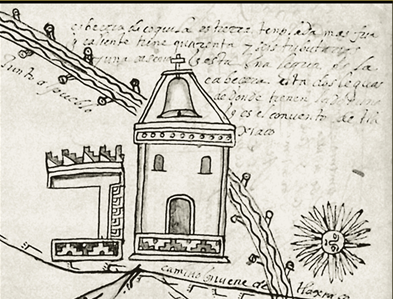
Description: The place-names that residents of the Mexica capital of Tenochtitlan (today Mexico City) gave to their city were both descriptive of topography and commemorative of history. Largely effaced from the Spanish historical register, Mexico City’s Nahuatl place-names were rescued from historical oblivion by José Antonio Alzate in the eighteenth century and again by Alfonso Caso in the twentieth. However, effacement is not equal to extinction, and this article argues for the continued use, even creation, of Nahuatl place-names into the eighteenth century. It suggests that the scholar’s desire to use place-names as an index to a pre-Hispanic past has obscured the vital presence of the city’s Nahua people, and their language, in the colonial period.
Teaching ideas: The article’s central exercise (recovering the histories hidden inside place names) can lead to a classroom activity in which students choose a city they know well and investigate the origins of two or three of its neighborhood or street names, presenting their findings to the class and discussing what these names reveal about who has historically had the power to name places, and whose histories get commemorated or erased. Barbara Mundy’s distinction between place names that are descriptive of topography and those that are commemorative of history offers a useful analytical framework for this. The article’s argument that the scholarly desire to treat place names as a window onto the pre-Hispanic past has obscured the living presence of Nahua people and their language in the colonial period can then be the basis for a discussion about how we can read historical sources and whose continuity we tend to make visible or invisible, practicing structures for argumentation. This text pairs well with the “Retrato de Tenochtitlan” and the desecation articles to build a richer picture of how the city’s indigenous past is remembered and contested.
URL: https://research.library.fordham.edu/art_hist_facultypubs/9/